NEET Mock — Blueprint Demo
A steady current of 1.5 A flows through a copper voltameter for 10 minutes. If the electrochemical equivalent of copper is 30 × 10⁻⁵ g C⁻¹, the mass of copper deposited on the electrode will be:
A solenoid of 1200 turns is wound uniformly in a single layer on a glass tube 2 m long and 0.2 m in diameter. The magnetic intensity at the center of the solenoid when a current of 2 A flows through it is:
A coil is placed in magnetic field such that plane of coil is perpendicular to the direction of magnetic field. The magnetic flux through a coil can be changed:
A. By changing the magnitude of the magnetic field within the coil.
B. By changing the area of coil within the magnetic field.
C. By changing the angle between the direction of magnetic field and the plane of the coil.
D. By reversing the magnetic field direction abruptly without changing its magnitude.
Choose the most appropriate answer from the options given below:
This question has Statement I and Statement II. Of the four choices given after the Statements, choose the one that best describes the two Statements.
Statement-I: Higher the range, greater is the resistance of ammeter.
Statement-II: To increase the range of ammeter, additional shunt needs to be used across it.
An electrical power line, having a total resistance of 2 Ω, delivers 1 kW at 220 V. The efficiency of the transmission line is approximately:
The provided text is incomplete: "In a moving coil galvanometer, two moving coils M1 and M2 have the following particulars: R1". Which of the following is the most appropriate conclusion?
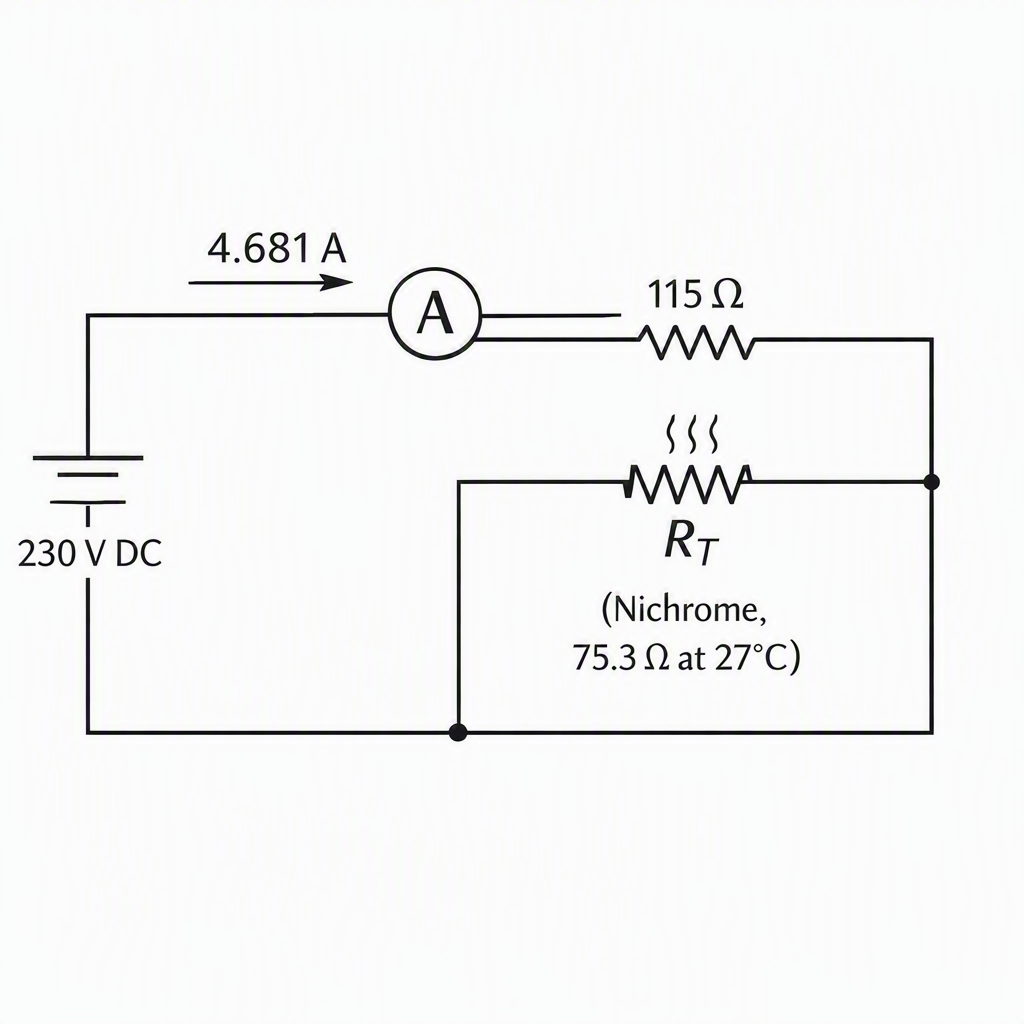
A 230 V ideal DC source is connected across two parallel branches. The first branch contains a 115 Ω resistor, while the second branch contains a nichrome heating element. An ideal ammeter in the main wire measures a total current of 4.681 A. The resistance of the nichrome element at 27 °C is 75.3 Ω, and its average temperature coefficient of resistance is 1.70 × 10^-4 °C^-1. Assuming the resistance-temperature relation R_T = R_27[1 + α(T - 27 °C)] remains valid, the steady temperature of the nichrome element is approximately:
A tightly wound circular coil has 100 turns, radius 0.10 m, and carries a current of 1.0 A. A proton is placed at the centre of the coil and moves with speed 6.0 × 10^5 m s^-1 perpendicular to the magnetic field at that point. Find the instantaneous radius of curvature of the proton's path. Take μ0 = 4π × 10^-7 T m A^-1, π = 3.14, proton mass mp = 1.67 × 10^-27 kg, and proton charge e = 1.60 × 10^-19 C.
A galvanometer of resistance 50 Ω has 25 divisions. A current of 4 × 10⁻⁴ A gives a deflection of one division. To convert this galvanometer into a voltmeter having a range of 25 V, it should be connected with a resistance of:
The resistance of a galvanometer is 50 Ω and the current required to give full-scale deflection is 100 µA. In order to convert it into an ammeter for reading up to 10 A, it is necessary to put a resistance of
🔒 35 more questions in the full paper
Full papers, answer keys and your institute's branding are available to institutes.
Get Institute Access →